|

Case Study

-

Rappi App

Driving repeat orders & early retention in food delivery marketplaces

Project Overview

Company

Rappi

Industry

Food Delivery Marketplace Quick Commerce

Timeline

2025

My role

Senior Product Designer

Key actions

Growth Strategy Product Prioritization KPI Definition UX/UI Design Experiment Design

01. Context & Intent

From context to growth bets

This was an independent product strategy challenge based on public marketplace patterns, benchmarked delivery behaviors, and growth frameworks commonly used in high-frequency commerce products.

The goal was to simulate how my role embedded in Growth would approach a real retention problem with business rigor, measurable hypotheses, and execution-ready solutions.

Executive summary

Retention was the highest-leverage growth opportunity. Rather than broad redesigns, I identified two measurable lifecycle moments where small product changes could create compounding value.

Bet 1

Faster repeat purchase

Reduce friction for users who are willing to buy again. Opportunity is in speed, not motivation. They want to buy, but the product slows them down.

Existing Users

Low Complexity

Bet 1

Faster repeat purchase

Reduce friction for users who are willing to buy again. Opportunity is in speed, not motivation. They want to buy, but the product slows them down.

Existing Users

Low Complexity

Bet 1

Faster repeat purchase

Reduce friction for users who are willing to buy again. Opportunity is in speed, not motivation. They want to buy, but the product slows them down.

Existing Users

Low Complexity

Bet 2

First-Week habit formation

Increase the probability of a second successful order in the critical first 7 days. The second order is often the real "first win", it predicts D30 retention.

New Users

Behavioral Design

Bet 2

First-Week habit formation

Increase the probability of a second successful order in the critical first 7 days. The second order is often the real "first win", it predicts D30 retention.

New Users

Behavioral Design

Bet 2

First-Week habit formation

Increase the probability of a second successful order in the critical first 7 days. The second order is often the real "first win", it predicts D30 retention.

New Users

Behavioral Design

Bet 1

Faster repeat purchase

Reduce friction for users who are willing to buy again. Opportunity is in speed, not motivation. They want to buy, but the product slows them down.

Existing Users

Low Complexity

Bet 2

First-Week habit formation

Increase the probability of a second successful order in the critical first 7 days. The second order is often the real "first win", it predicts D30 retention.

New Users

Behavioral Design

Expected Business Impact

KPI

Opportunity Range

Driver

Repeat Orders / User

+8% to +12%

Bet 1 - Reorder shortcut

Second Order Conversion

+10% to +16%

Bet 2 - First-week challenge

D30 Retention Rate

+5% to +9%

Bet 2 - Habit formation

Checkout Completion Time

-20% to -28%

Bet 1 - Reduced flow steps

CAC Payback Period

Improved

Both bets - Higher LTV

02. The problem

Framing the core challenge

In marketplace businesses, acquisition can grow installs, but retention drives profitability. If users place only one discounted order and disappear, the economics break.

Marketplace Economics Logic

😟

😟

😟

1- Order User

CAC > Gross Margin

= Poor ROI

😄

😄

😄

3+ Order User

CAC < Gross Margin

= Healthy ROI

User lifecycle diagnosis

Segment A - Existing Users

Already trust the product, but repeat purchasing is too slow. They lack speed, not motivation.

"I know what I want, but ordering again takes too much effort."

  • ❌ Rebuilding the same basket from scratch

  • ❌ Repeating checkout steps every time

  • ❌ Too many taps for habitual purchases

Segment B - New Users

Completed first order, but no momentum toward a second. They lack motivation, not awareness.

"I already tried it once, but honestly I have no reason to go back."

  • ❌ No post-purchase momentum or follow-up

  • ❌ Weak incentive after the first order

  • ❌ First-week drop-off before habit forms

Segment A - Existing Users

Already trust the product, but repeat purchasing is too slow. They lack speed, not motivation.

"I know what I want, but ordering again takes too much effort."

  • ❌ Rebuilding the same basket from scratch

  • ❌ Repeating checkout steps every time

  • ❌ Too many taps for habitual purchases

Segment B - New Users

Completed first order, but no momentum toward a second. They lack motivation, not awareness.

"I already tried it once, but honestly I have no reason to go back."

  • ❌ No post-purchase momentum or follow-up

  • ❌ Weak incentive after the first order

  • ❌ First-week drop-off before habit forms

03. Discovery

Understanding user behavior

Research inputs: Using realistic proxy signals, including

  • Public app reviews

  • Delivery UX teardowns

  • Benchmark retention models

  • Consumer behavior patterns

  • Growth heuristics from commerce apps

  • Funnel assumptions based on category norms

Convenience wins on speed

When users know what they want, browsing becomes more complex. Fast orders are the key to driving repeat purchases.

Motivation drives habit

A second successful order is a strong predictor of long-term retention. Timing the incentive right is very critical for habit.

Simplicity builds confidence

Less cognitive load increases completion. Every unnecessary extra step at checkout is a potential exit point for users.

Incentives must be efficient

Bad rewards create CAC without loyalty. Threshold-based credits are more sustainable than using simple flat discounts.

Convenience wins on speed

When users know what they want, browsing becomes more complex. Fast orders are the key to driving repeat purchases.

Simplicity builds confidence

Less cognitive load increases completion. Every unnecessary extra step at checkout is a potential exit point for users.

Motivation drives habit

A second successful order is a strong predictor of long-term retention. Timing the incentive right is very critical for habit.

Incentives must be efficient

Bad rewards create CAC without loyalty. Threshold-based credits are more sustainable than using simple flat discounts.

Convenience wins on speed

When users know what they want, browsing becomes more complex. Fast orders are the key to driving repeat purchases.

Motivation drives habit

A second successful order is a strong predictor of long-term retention. Timing the incentive right is very critical for habit.

Simplicity builds confidence

Less cognitive load increases completion. Every unnecessary extra step at checkout is a potential exit point for users.

Incentives must be efficient

Less cognitive load increases completion. Every unnecessary extra step at checkout is a potential exit point for users.

04. Strategy & Key decisions

Choosing where to focus

With 10+ opportunities on the table, a structured framework filtered for speed-to-signal and business impact, not just effort.

Opportunities considered

  1. Reorder shortcut

  2. Welcome bonus x2 orders

  3. Loyalty points system

  4. Flexible subscription plan

  5. Personalized frequent orders

  6. Cashback wallet expansion

  7. Repurchase missions

  8. Dynamic offers

  9. Gamified tutorial

  10. Onboarding with initial personalization

Decision framework

0%

0%

Impact Potential

0%

0%

Impact Potential

0%

0%

Impact Potential

0%

0%

Impact Potential

0%

0%

Learning Speed

0%

0%

Learning Speed

0%

0%

Learning Speed

0%

0%

Learning Speed

0%

0%

Build Complexity

0%

0%

Build Complexity

0%

0%

Build Complexity

0%

0%

Build Complexity

0%

0%

Operational Risk

0%

0%

Operational Risk

0%

0%

Operational Risk

0%

0%

Operational Risk

Strategic trade-offs

❌ Loyalty system

Too slow to validate. Operationally broad. Needs full product commitment before a single data point is available.

❌ Loyalty system

Too slow to validate. Operationally broad. Needs full product commitment before a single data point is available.

❌ Loyalty system

Too slow to validate. Operationally broad. Needs full product commitment before a single data point is available.

❌ Loyalty system

Too slow to validate. Operationally broad. Needs full product commitment before a single data point is available.

❌ Subscription model

Requires pricing strategy and complex logistics depth. Wrong assumptions at this stage would be costly to unwind.

❌ Subscription model

Requires pricing strategy and complex logistics depth. Wrong assumptions at this stage would be costly to unwind.

❌ Subscription model

Requires pricing strategy and complex logistics depth. Wrong assumptions at this stage would be costly to unwind.

❌ Subscription model

Requires pricing strategy and complex logistics depth. Wrong assumptions at this stage would be costly to unwind.

❌ Onboarding

Too slow to validate. Operationally broad. Needs full product commitment before a single data point is available.

❌ Onboarding

Too slow to validate. Operationally broad. Needs full product commitment before a single data point is available.

❌ Onboarding

Too slow to validate. Operationally broad. Needs full product commitment before a single data point is available.

❌ Onboarding

Too slow to validate. Operationally broad. Needs full product commitment before a single data point is available.

05. Solutions

Two bets, two moments, one system

Each solution targets a lifecycle moment with a measurable hypothesis, designed to be validated quickly before scaling.

Solution A

Reorder in 1 tap

Reorder in 1 tap

Reorder in 1 tap

Reducing repeat friction for existing users

Hypothesis: "If users can repurchase familiar baskets in under 90 seconds, repeat order frequency will increase."
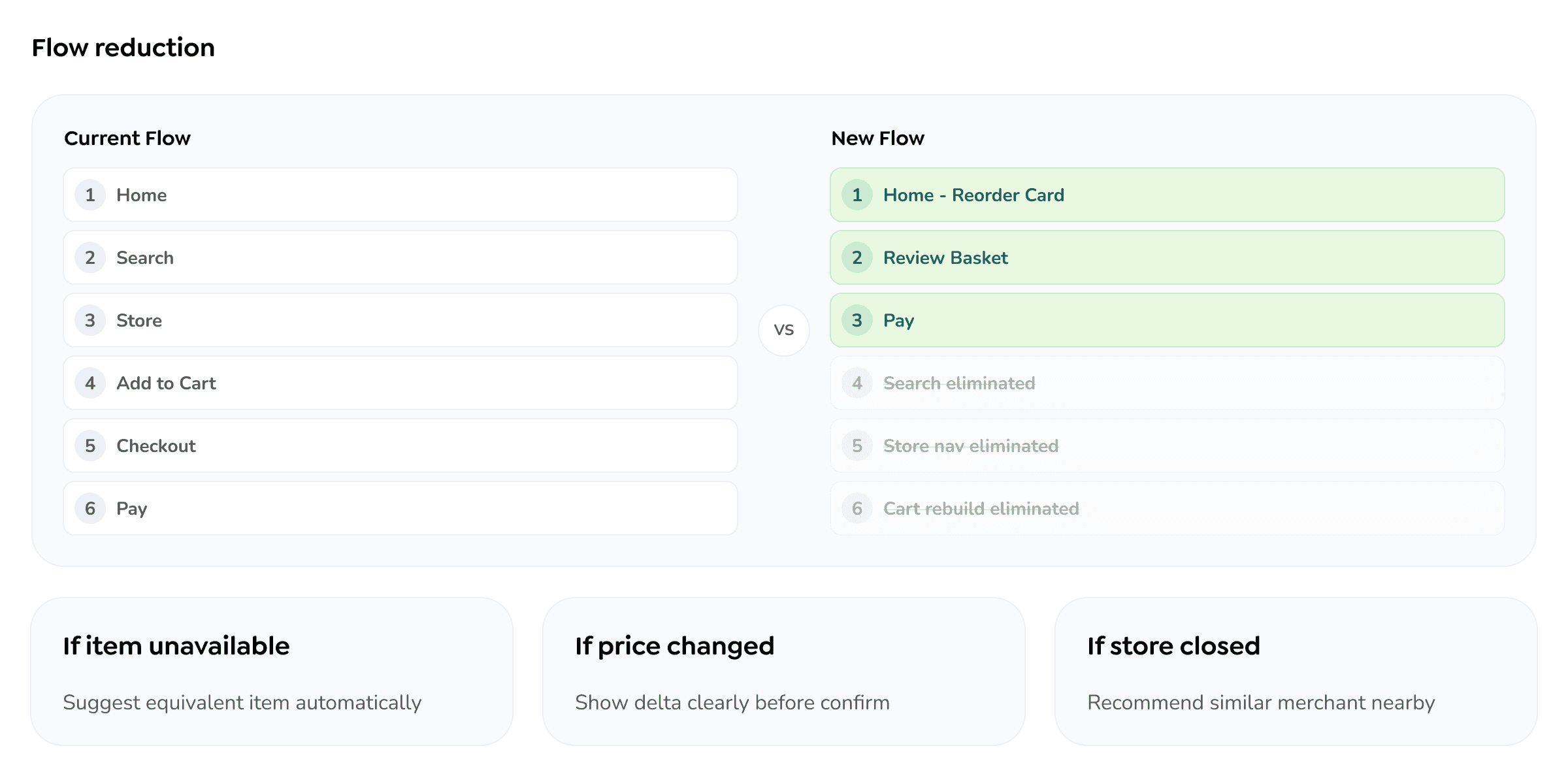
KPI targets

0.0

0.0

Baseline: 1.30
Repeat orders/user

0.0

0.0

Baseline: 1.30
Repeat orders/user

0.0

0.0

Baseline: 1.30
Repeat orders/user

0.0

0.0

Baseline: 1.30
Repeat orders/user

0.0 min

0.0 min

Baseline: 3.2 min
Checkout Time

0.0 min

0.0 min

Baseline: 3.2 min
Checkout Time

0.0 min

0.0 min

Baseline: 3.2 min
Checkout Time

0.0 min

0.0 min

Baseline: 3.2 min
Checkout Time

0%

0%

Baseline: 71%
Conversion to Pay

0%

0%

Baseline: 71%
Conversion to Pay

0%

0%

Baseline: 71%
Conversion to Pay

0%

0%

Baseline: 71%
Conversion to Pay

0%

0%

Baseline: 74%
CSAT Score

0%

0%

Baseline: 74%
CSAT Score

0%

0%

Baseline: 74%
CSAT Score

0%

0%

Baseline: 74%
CSAT Score

Solution B

Welcome bonus ×2 orders

Welcome bonus ×2 orders

Welcome bonus ×2 orders

Driving early habit formation for new users

Hypothesis: "Users who complete a second order quickly are significantly more likely to be retained at day 30."

KPI targets

0.0%

0.0%

Baseline: 22%
2nd Order ≤ 7d

0.0%

0.0%

Baseline: 22%
2nd Order ≤ 7d

0.0%

0.0%

Baseline: 22%
2nd Order ≤ 7d

0.0%

0.0%

Baseline: 22%
2nd Order ≤ 7d

0%

0%

Baseline: 19%
D30 Retention

0%

0%

Baseline: 19%
D30 Retention

0%

0%

Baseline: 19%
D30 Retention

0%

0%

Baseline: 19%
D30 Retention

0%

0%

Baseline: 9%
Push CTR

0%

0%

Baseline: 9%
Push CTR

0%

0%

Baseline: 9%
Push CTR

0%

0%

Baseline: 9%
Push CTR

+ROI

Via cohort
Reward ROI

+ROI

Via cohort
Reward ROI

+ROI

Via cohort
Reward ROI

+ROI

Via cohort
Reward ROI

06. Cross-functional Execution

Collaboration at scale

Delivering this sprint required simulating partnership across five functions. Each team had a defined role, clear ask, and measurable output.

Stakeholder Alignment Map

Product Manager

Align success metrics and MVP scope. Prioritize features for sprint 1 vs. future phases.

Product Manager

Align success metrics and MVP scope. Prioritize features for sprint 1 vs. future phases.

Product Manager

Align success metrics and MVP scope. Prioritize features for sprint 1 vs. future phases.

Product Manager

Align success metrics and MVP scope. Prioritize features for sprint 1 vs. future phases.

Data Analyst

Define event taxonomy and cohort tracking. Set up funnel instrumentation for A/B reads.

Data Analyst

Define event taxonomy and cohort tracking. Set up funnel instrumentation for A/B reads.

Data Analyst

Define event taxonomy and cohort tracking. Set up funnel instrumentation for A/B reads.

Data Analyst

Define event taxonomy and cohort tracking. Set up funnel instrumentation for A/B reads.

Engineering

Reduce scope to low-risk launchable version. Identify reorder API feasibility and edge cases.

Engineering

Reduce scope to low-risk launchable version. Identify reorder API feasibility and edge cases.

Engineering

Reduce scope to low-risk launchable version. Identify reorder API feasibility and edge cases.

Engineering

Reduce scope to low-risk launchable version. Identify reorder API feasibility and edge cases.

CRM / Growth Ops

Define notification timing and channel strategy. Enforce frequency caps to prevent fatigue.

CRM / Growth Ops

Define notification timing and channel strategy. Enforce frequency caps to prevent fatigue.

CRM / Growth Ops

Define notification timing and channel strategy. Enforce frequency caps to prevent fatigue.

CRM / Growth Ops

Define notification timing and channel strategy. Enforce frequency caps to prevent fatigue.

Operations

Merchant availability, reorder logic, and item substitute database for edge case handling.

Operations

Merchant availability, reorder logic, and item substitute database for edge case handling.

Operations

Merchant availability, reorder logic, and item substitute database for edge case handling.

Operations

Merchant availability, reorder logic, and item substitute database for edge case handling.

07. Experimentation & Scalability

Validating Impact

Both solutions designed as A/B tests from day one with a clear control, variant, and measurement plan. No assumption ships without a signal.

Test A - Reorder Surface

Homepage reorder card

  • CTR on reorder card

  • Checkout completion rate

  • Repeat order rate (7-day, 30-day)

Control:
Existing homepage, no reorder UI

Variant:
Reorder card above the fold

Test A - Reorder Surface

Homepage reorder card

  • CTR on reorder card

  • Checkout completion rate

  • Repeat order rate (7-day, 30-day)

Control:
Existing homepage, no reorder UI

Variant:
Reorder card above the fold

Test A - Reorder Surface

Homepage reorder card

  • CTR on reorder card

  • Checkout completion rate

  • Repeat order rate (7-day, 30-day)

Control:
Existing homepage, no reorder UI

Variant:
Reorder card above the fold

Test B - Welcome Challenge

First-week habit program

  • Second order rate (≤ 7 days)

  • D30 retention cohort

  • Incentive cost per retained user

  • AOV and CSAT

Control:
Standard onboarding, no challenge

Variant:
2-order challenge in 7 days

Test B - Welcome Challenge

First-week habit program

  • Second order rate (≤ 7 days)

  • D30 retention cohort

  • Incentive cost per retained user

  • AOV and CSAT

Control:
Standard onboarding, no challenge

Variant:
2-order challenge in 7 days

Test B - Welcome Challenge

First-week habit program

  • Second order rate (≤ 7 days)

  • D30 retention cohort

  • Incentive cost per retained user

  • AOV and CSAT

Control:
Standard onboarding, no challenge

Variant:
2-order challenge in 7 days

Test A - Reorder Surface

Homepage reorder card

  • CTR on reorder card

  • Checkout completion rate

  • Repeat order rate (7-day, 30-day)

Control:
Existing homepage, no reorder UI

Variant:
Reorder card above the fold

Test B - Welcome Challenge

First-week habit program

  • Second order rate (≤ 7 days)

  • D30 retention cohort

  • Incentive cost per retained user

  • AOV and CSAT

Control:
Standard onboarding, no challenge

Variant:
2-order challenge in 7 days

Designing for Systems — Scalability Thinking

Growth component library

✓ Reorder card

✓ Progress widget

✓ Reward banners

✓ Promo states

Growth rules engine

✓ Trigger logic

✓ Eligibility rules

✓ Incentive catalog

✓ User segmentation

Notification orchestration

✓ Timing rules

✓ Frequency caps

✓ Contextual reminders

✓ Channel selection

Notification orchestration

✓ Timing rules

✓ Frequency caps

✓ Contextual reminders

✓ Channel selection

08. Risks & Mitigation

Managing Trade-offs

Every growth initiative introduces risk. Here's how the most critical failure modes were anticipated and addressed before launch.

Trade-offs

Risk

Severity

Mitigation strategy

Promo abuse by bad actors

High

Device and payment fingerprint checks. Challenge only available to verified accounts.

Push notification fatigue

Med

Strict frequency caps at 1 push/day. Opt-out clearly surfaced. A/B test notification cadence.

Wrong items in reorder flow

Med

Mandatory editable review step before payment. User always sees basket before confirming.

Margin pressure from credits

High

Threshold-based credits only. Reward only activates above minimum basket value.

Over-complex rollout

Low

MVP scope first. Pilot in single market. Full rollout gated on conversion data from test cohort.

09. Roadmap

From concept to MVP

A phased rollout designed to learn quickly while controlling complexity, always gated on signals from the previous phase.

Business Impact Dashboard
10. Key Learnings

What this challenge taught me

01

Retention is a system, not features

No single feature retains users. Combining UX, CRM timing, incentives, and data loops together makes retention compound.

02

Second order is the real first win

In marketplaces, first orders use promos. The second order reveals true preference and is worth designing.

03

Constraints force better bets

A prioritized framework prevents building everything. Two focused bets beat a scattered roadmap full of extra features.

04

Design the data story first

Defining metrics before solutions made decisions sharper. A KPI tree keeps teams aligned and cuts debates.

05

Edge cases are product strategy

Reorder flow's edge cases such as unavailable items, price shifts, and closed stores are opportunities to reinforce trust at the critical moment.

06

Think in systems from day one

Building reorder cards and challenge widgets as reusable components makes the next growth sprints 10x faster.

Have a product worth scaling?

I help teams turn complex ideas into products users adopt, trust, and rely on

Have a product worth scaling?

I help teams turn complex ideas into products users adopt, trust, and rely on

Have a product worth scaling?

I help teams turn complex ideas into products users adopt, trust, and rely on

Have a product worth scaling?

I help teams turn complex ideas into products users adopt, trust, and rely on

Have a product worth scaling?

I help teams turn complex ideas into products users adopt, trust, and rely on

Create a free website with Framer, the website builder loved by startups, designers and agencies.