Case Study
-
Quipu Design System
Building a Scalable Infrastructure for Multi-Product Growth


Project Overview
Company
Chazki
Industry
Logistics Last-mile delivery Operations
Period
2021 - 2022
My role
Lead UX Designer
Key actions
DS Architecture Definition Token & Component System Governance & Versioning Model Cross-Squad Executive Alignment SaaS Pilot & Scaled Adoption
01. Context
Scaling required infrastructure
By 2021, Chazki was already experiencing accelerated business expansion:
At that stage, the challenge was not visual alignment. The real need was building product infrastructure capable of sustaining multi-product growth without amplifying organizational entropy across teams and platforms.
Quipu was not a UI library. It was a structural intervention to reduce systemic risk while the company was growing 60%+ year over year.
02. Problem
The cost of inconsistency
As Chazki scaled rapidly, the absence of a unified system revealed deep structural weaknesses. This was a foundational scalability risk, not just a design issue.


03. Constraints & Complexity
Small team. No pause button
The commercial roadmap could not stop. Every constraint required strategic navigation, not workarounds.


04. Strategy & Key Decisions
Growth vs. debt
I structured a decision framework that mapped each critical situation through the following process:
Problem → Risk → Decision → Trade-off → Impact


This framework positioned Quipu not as a design initiative, but as product infrastructure designed to reduce systemic entropy while the organization scaled.
05. System Architecture
Designing Infrastructure for Multi-Product Scale
Quipu was built as a design-engineering infrastructure capable of supporting multiple products, regional variations, and independent squads without increasing system entropy.
1. Core architecture
Quipu used a five-layer model controlling abstraction from primitives to product-level layouts, ensuring consistent visual propagation and controlled customization.


2. Token strategy
Tokens connected design and engineering. Quipu removed hardcoded visual decisions using a 4-level token structure that prevented system fragmentation.
Because Chazki operated across multiple markets, regional differences were managed through token overrides, not independent UI versions.


3. Ant Design integration
Instead of replacing Ant Design, Quipu implemented a controlled extension strategy. Ant Design handled base components while Quipu controlled tokens, styles, and behavior.


4. Governance model
Quipu implemented a 5-stage pipeline governance structure that balances squad autonomy with systemic integrity, preventing uncontrolled UI divergence across all products.


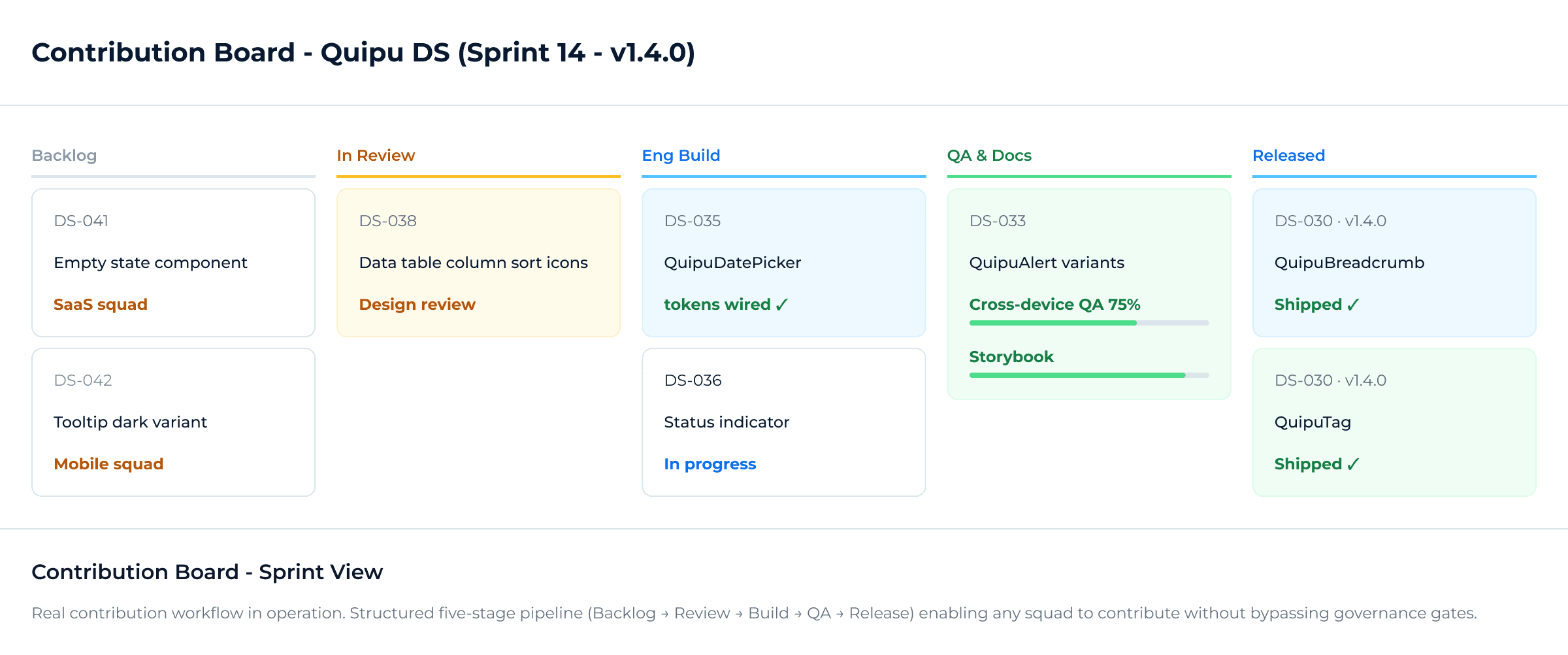
5. Contribution workflow
A structured contribution process allowed teams to improve the system while respecting governance and maintaining alignment between squads and the DS team.

6. Figma-to-code alignment
To avoid design-code divergence, Quipu defined 4 alignment mechanisms to ensure what designers created was exactly what engineers shipped.


7. Deliverables
The following artifacts validated the system architecture and supported operational continuity across design, engineering, and governance functions.


Strategic Outcome
Quipu transformed design from visual execution into infrastructure, a scalable design-engineering platform capable of supporting multi-product growth, enterprise consistency, predictable delivery velocity, and reduced technical debt.
06. Cross-Functional Influence
Beyond design & engineering
The real work was organizational. Involved managing resistance, building trust, and turning skeptics into advocates at every level of the company.


07. Implementation & Adoption
Strategy → Pilot → Scale
A phased rollout minimized friction while scaling structural muscle. A success-driven approach over big-bang migrations.
Result


08. Business Impact
Design as financial infrastructure
Quipu directly influenced 3 strategic KPIs that connected design decisions to revenue, cost, and retention outcomes.
Revenue Connection


09. Key Learnings
Strategic retrospective
I’ve realized that a design system is 10% components and 90% alignment. These five principles now shape my approach to every foundational initiative.
01
Cultural risk outweighs any technical debt.
02
Prioritize architecture to enable future speed.
03
Systems decay rapidly without active governance.
04
Adoption must be an intentionally designed product.
05
Invisible infrastructure sustains visible revenue.