Case Study
-
Quipu Design System
Building a Scalable Infrastructure for Multi-Product Growth
Building a Scalable Infrastructure for Multi-Product Growth

Project Overview
Company
Chazki
Industry
Logistics Last-mile delivery Operations
Period
2021 - 2022
My role
Lead UX Designer
Key actions
DS Architecture Definition Token & Component System Governance & Versioning Model Cross-Squad Executive Alignment SaaS Pilot & Scaled Adoption
01. Context
Scaling required infrastructure
By 2021, Chazki was already experiencing accelerated business expansion:
60%+ annual growth
USD 20M ARR
700+ enterprise clients
Regional expansion
At that stage, the challenge was not visual alignment. The real need was building product infrastructure capable of sustaining multi-product growth without amplifying organizational entropy across teams and platforms.
Quipu was not a UI library. It was a structural intervention to reduce systemic risk while the company was growing 60%+ year over year.
02. Problem
The cost of inconsistency
As Chazki scaled rapidly, the absence of a unified system revealed deep structural weaknesses. This was a foundational scalability risk, not just a design issue.
The Problem
Inconsistent use of Ant Design across squads.
Undocumented component overrides.
Uncontrolled regional variants accumulating.
Marketing designing outside the ecosystem.
700+ enterprise clients demanding coherence.
New features increased structural complexity at a compounding rate.
The Problem
Inconsistent use of Ant Design across squads.
Undocumented component overrides.
Uncontrolled regional variants accumulating.
Marketing designing outside the ecosystem.
700+ enterprise clients demanding coherence.
New features increased structural complexity at a compounding rate.
The Problem
Inconsistent use of Ant Design across squads.
Undocumented component overrides.
Uncontrolled regional variants accumulating.
Marketing designing outside the ecosystem.
700+ enterprise clients demanding coherence.
New features increased structural complexity at a compounding rate.
The Risk
Exponential growth of technical debt.
Slower releases across all squads.
Increased operational cost per client.
Loss of enterprise UX coherence.
UI friction impacting adoption and NRR.
With USD 20M in ARR at stake, inconsistency became a financial risk.
The Risk
Exponential growth of technical debt.
Slower releases across all squads.
Increased operational cost per client.
Loss of enterprise UX coherence.
UI friction impacting adoption and NRR.
With USD 20M in ARR at stake, inconsistency became a financial risk.
The Risk
Exponential growth of technical debt.
Slower releases across all squads.
Increased operational cost per client.
Loss of enterprise UX coherence.
UI friction impacting adoption and NRR.
With USD 20M in ARR at stake, inconsistency became a financial risk.


02. Problem
The cost of inconsistency
As Chazki scaled rapidly, the absence of a unified system revealed deep structural weaknesses. This was a foundational scalability risk, not just a design issue.
The Problem
Inconsistent use of Ant Design across squads.
Undocumented component overrides.
Uncontrolled regional variants accumulating.
Marketing designing outside the ecosystem.
700+ enterprise clients demanding coherence.
New features increased structural complexity at a compounding rate.
The Risk
Exponential growth of technical debt.
Slower releases across all squads.
Increased operational cost per client.
Loss of enterprise UX coherence.
UI friction impacting adoption and NRR.
With USD 20M in ARR at stake, inconsistency became a financial risk.
03. Constraints & Complexity
Small team. No pause button
The commercial roadmap could not stop. Every constraint required strategic navigation, not workarounds.
Primary challenge
Organizational alignment around invisible infrastructure with long-term value while Chazki scaled 60%+ annually.
Primary challenge
Organizational alignment around invisible infrastructure with long-term value while Chazki scaled 60%+ annually.
Primary challenge
Organizational alignment around invisible infrastructure with long-term value while Chazki scaled 60%+ annually.
A small team
3 UX designers, 2 product roles, and 7 developers operating under constant daily commercial roadmap pressure.
A small team
3 UX designers, 2 product roles, and 7 developers operating under constant daily commercial roadmap pressure.
A small team
3 UX designers, 2 product roles, and 7 developers operating under constant daily commercial roadmap pressure.
Founders' concern
Risk of losing operational & commercial focus during a period of active expansion.
Founders' concern
Risk of losing operational & commercial focus during a period of active expansion.
Founders' concern
Risk of losing operational & commercial focus during a period of active expansion.
Marketing resistance
Resistance to migrating from SquareSpace to the new system's workflows.
Marketing resistance
Resistance to migrating from SquareSpace to the new system's workflows.
Marketing resistance
Resistance to migrating from SquareSpace to the new system's workflows.
Regulatory variations
Region-specific UI requirements driven by regulatory compliance across markets.
Regulatory variations
Region-specific UI requirements driven by regulatory compliance across markets.
Regulatory variations
Region-specific UI requirements driven by regulatory compliance across markets.
Limited engineering
7 developers with active sprint commitments requiring incremental adoption.
Limited engineering
7 developers with active sprint commitments requiring incremental adoption.
Limited engineering
7 developers with active sprint commitments requiring incremental adoption.


03. Constraints & Complexity
Small team. No pause button
The commercial roadmap could not stop. Every constraint required strategic navigation, not workarounds.
Primary challenge
Organizational alignment around invisible infrastructure with long-term value while Chazki scaled 60%+ annually.
A small team
3 UX designers, 2 product roles, and 7 developers operating under constant daily commercial roadmap pressure.
Founders' concern
Risk of losing operational & commercial focus during a period of active expansion.
Marketing resistance
Resistance to migrating from SquareSpace to the new system's workflows.
Regulatory variations
Region-specific UI requirements driven by regulatory compliance across markets.
Limited engineering
7 developers with active sprint commitments requiring incremental adoption.
04. Strategy & Key Decisions
Growth vs. debt
I structured a decision framework that mapped each critical situation through the following process:
Problem → Risk → Decision → Trade-off → Impact
01
Problem
Inconsistent UI patterns
Risk
Fragmented UX across products
Decision
Token architecture first
Trade-off
Slower initial UI delivery
Long-term Impact
Created scalable foundations that reduced future refactors and and reducing long-term technical debt
01
Problem
Inconsistent UI patterns
Risk
Fragmented UX across products
Decision
Token architecture first
Trade-off
Slower initial UI delivery
Long-term Impact
Created scalable foundations that reduced future refactors and and reducing long-term technical debt
01
Problem
Inconsistent UI patterns
Risk
Fragmented UX across products
Decision
Token architecture first
Trade-off
Slower initial UI delivery
Long-term Impact
Created scalable foundations that reduced future refactors and and reducing long-term technical debt
02
Problem
Divergent squad practices
Risk
Design fragmentation
Decision
Centralized system governance
Trade-off
Reduced early squad autonomy
Long-term Impact
Enabled consistent cross-product decisions while keeping system evolution aligned with business growth
02
Problem
Divergent squad practices
Risk
Design fragmentation
Decision
Centralized system governance
Trade-off
Reduced early squad autonomy
Long-term Impact
Enabled consistent cross-product decisions while keeping system evolution aligned with business growth
02
Problem
Divergent squad practices
Risk
Design fragmentation
Decision
Centralized system governance
Trade-off
Reduced early squad autonomy
Long-term Impact
Enabled consistent cross-product decisions while keeping system evolution aligned with business growth
03
Problem
Unproven system value
Risk
Low organizational adoption
Decision
SaaS pilot before scaling
Trade-off
Slower organization-wide rollout
Long-term Impact
Early validation improved adoption and reduced implementation risk before scaling system across teams
03
Problem
Unproven system value
Risk
Low organizational adoption
Decision
SaaS pilot before scaling
Trade-off
Slower organization-wide rollout
Long-term Impact
Early validation improved adoption and reduced implementation risk before scaling system across teams
03
Problem
Unproven system value
Risk
Low organizational adoption
Decision
SaaS pilot before scaling
Trade-off
Slower organization-wide rollout
Long-term Impact
Early validation improved adoption and reduced implementation risk before scaling system across teams
04
Problem
Regional UI requirements
Risk
Platform fragmentation
Decision
Controlled regional variants
Trade-off
Higher design coordination effort
Long-term Impact
Balanced regulatory needs with system coherence, avoiding fragmentation across markets and products
04
Problem
Regional UI requirements
Risk
Platform fragmentation
Decision
Controlled regional variants
Trade-off
Higher design coordination effort
Long-term Impact
Balanced regulatory needs with system coherence, avoiding fragmentation across markets and products
04
Problem
Regional UI requirements
Risk
Platform fragmentation
Decision
Controlled regional variants
Trade-off
Higher design coordination effort
Long-term Impact
Balanced regulatory needs with system coherence, avoiding fragmentation across markets and products
05
Problem
Marketing outside ecosystem
Risk
Brand inconsistency
Decision
Marketing migration later
Trade-off
Temporary ecosystem fragmentation
Long-term Impact
Reduced resistance and enabled gradual alignment of marketing experiences with product design system
05
Problem
Marketing outside ecosystem
Risk
Brand inconsistency
Decision
Marketing migration later
Trade-off
Temporary ecosystem fragmentation
Long-term Impact
Reduced resistance and enabled gradual alignment of marketing experiences with product design system
05
Problem
Marketing outside ecosystem
Risk
Brand inconsistency
Decision
Marketing migration later
Trade-off
Temporary ecosystem fragmentation
Long-term Impact
Reduced resistance and enabled gradual alignment of marketing experiences with product design system
06
Problem
Limited engineering bandwidth
Risk
System adoption delays
Decision
Incremental engineering adoption
Trade-off
Slower initial component coverage
Long-term Impact
Allowed engineering integration without blocking product delivery or disrupting active sprint commitments
06
Problem
Limited engineering bandwidth
Risk
System adoption delays
Decision
Incremental engineering adoption
Trade-off
Slower initial component coverage
Long-term Impact
Allowed engineering integration without blocking product delivery or disrupting active sprint commitments
06
Problem
Limited engineering bandwidth
Risk
System adoption delays
Decision
Incremental engineering adoption
Trade-off
Slower initial component coverage
Long-term Impact
Allowed engineering integration without blocking product delivery or disrupting active sprint commitments


This framework positioned Quipu not as a design initiative, but as product infrastructure designed to reduce systemic entropy while the organization scaled.
04. Strategy & Key Decisions
Growth vs. debt
I structured a decision framework that mapped each critical situation through the following process:
Problem → Risk → Decision → Trade-off → Impact
01
Problem
Inconsistent UI patterns
Risk
Fragmented UX across products
Decision
Token architecture first
Trade-off
Slower initial UI delivery
Long-term Impact
Created scalable foundations that reduced future refactors and and reducing long-term technical debt
02
Problem
Divergent squad practices
Risk
Design fragmentation
Decision
Centralized system governance
Trade-off
Reduced early squad autonomy
Long-term Impact
Enabled consistent cross-product decisions while keeping system evolution aligned with business growth
03
Problem
Unproven system value
Risk
Low organizational adoption
Decision
SaaS pilot before scaling
Trade-off
Slower organization-wide rollout
Long-term Impact
Early validation improved adoption and reduced implementation risk before scaling system across teams
04
Problem
Regional UI requirements
Risk
Platform fragmentation
Decision
Controlled regional variants
Trade-off
Higher design coordination effort
Long-term Impact
Balanced regulatory needs with system coherence, avoiding fragmentation across markets and products
05
Problem
Marketing outside ecosystem
Risk
Brand inconsistency
Decision
Marketing migration later
Trade-off
Temporary ecosystem fragmentation
Long-term Impact
Reduced resistance and enabled gradual alignment of marketing experiences with product design system
06
Problem
Limited engineering bandwidth
Risk
System adoption delays
Decision
Incremental engineering adoption
Trade-off
Slower initial component coverage
Long-term Impact
Allowed engineering integration without blocking product delivery or disrupting active sprint commitments
This framework positioned Quipu not as a design initiative, but as product infrastructure designed to reduce systemic entropy while the organization scaled.
05. System Architecture
Designing Infrastructure for Multi-Product Scale
Quipu was built as a design-engineering infrastructure capable of supporting multiple products, regional variations, and independent squads without increasing system entropy.
1. Core architecture
Quipu used a five-layer model controlling abstraction from primitives to product-level layouts, ensuring consistent visual propagation and controlled customization.


2. Token strategy
Tokens connected design and engineering. Quipu removed hardcoded visual decisions using a 4-level token structure that prevented system fragmentation.
Because Chazki operated across multiple markets, regional differences were managed through token overrides, not independent UI versions.


3. Ant Design integration
Instead of replacing Ant Design, Quipu implemented a controlled extension strategy. Ant Design handled base components while Quipu controlled tokens, styles, and behavior.


4. Governance model
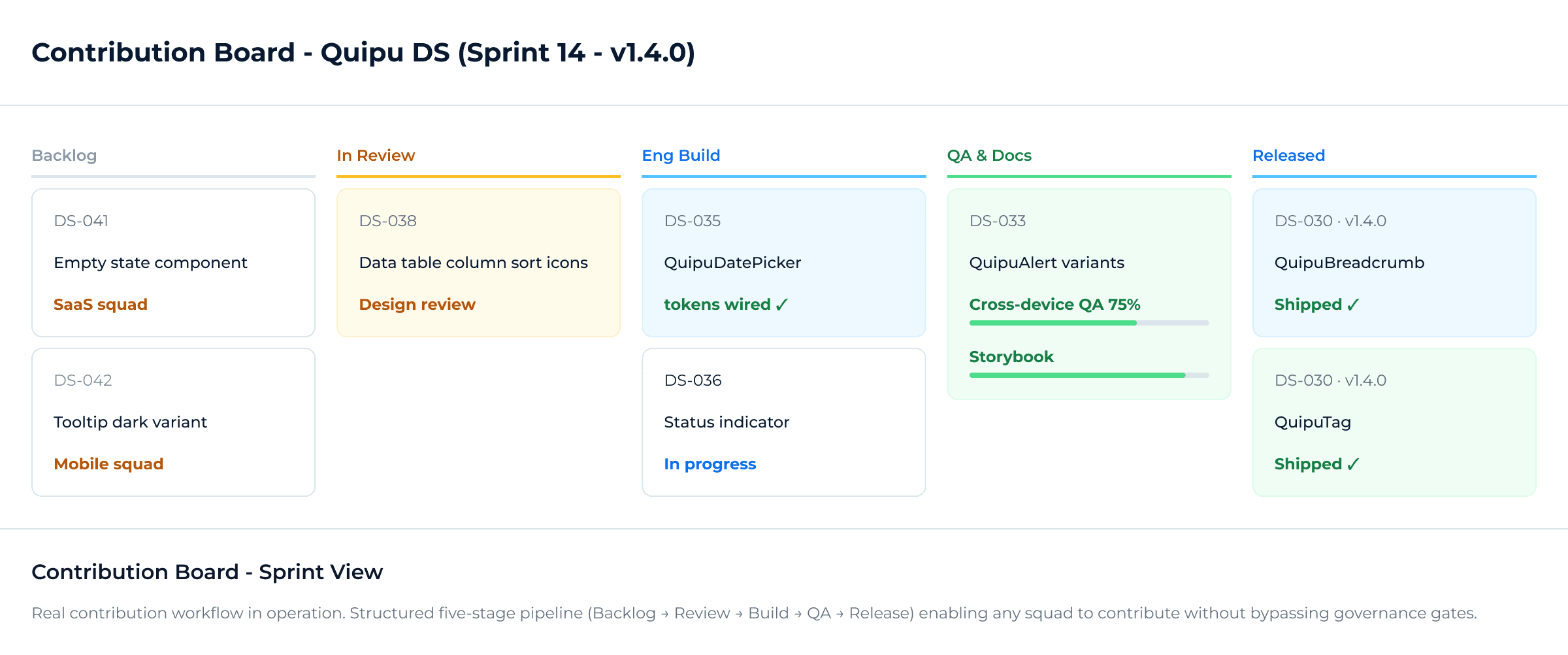
Quipu implemented a 5-stage pipeline governance structure that balances squad autonomy with systemic integrity, preventing uncontrolled UI divergence across all products.


5. Contribution workflow
A structured contribution process allowed teams to improve the system while respecting governance and maintaining alignment between squads and the DS team.

6. Figma-to-code alignment
To avoid design-code divergence, Quipu defined 4 alignment mechanisms to ensure what designers created was exactly what engineers shipped.


7. Deliverables
The following artifacts validated the system architecture and supported operational continuity across design, engineering, and governance functions.


Strategic Outcome
Quipu transformed design from visual execution into infrastructure, a scalable design-engineering platform capable of supporting multi-product growth, enterprise consistency, predictable delivery velocity, and reduced technical debt.
05. System Architecture
Designing Infrastructure for Multi-Product Scale
Quipu was built as a design-engineering infrastructure capable of supporting multiple products, regional variations, and independent squads without increasing system entropy.
1. Core architecture
Quipu used a five-layer model controlling abstraction from primitives to product-level layouts, ensuring consistent visual propagation and controlled customization.
2. Token strategy
Tokens connected design and engineering. Quipu removed hardcoded visual decisions using a 4-level token structure that prevented system fragmentation.
Because Chazki operated across multiple markets, regional differences were managed through token overrides, not independent UI versions.
3. Ant Design integration
Instead of replacing Ant Design, Quipu implemented a controlled extension strategy. Ant Design handled base components while Quipu controlled tokens, styles, and behavior.
4. Governance model
Quipu implemented a 5-stage pipeline governance structure that balances squad autonomy with systemic integrity, preventing uncontrolled UI divergence across all products.
5. Contribution workflow
A structured contribution process allowed teams to improve the system while respecting governance and maintaining alignment between squads and the DS team.
6. Figma-to-code alignment
To avoid design-code divergence, Quipu defined 4 alignment mechanisms to ensure what designers created was exactly what engineers shipped.
7. Deliverables
The following artifacts validated the system architecture and supported operational continuity across design, engineering, and governance functions.
Strategic Outcome
Quipu transformed design from visual execution into infrastructure, a scalable design-engineering platform capable of supporting multi-product growth, enterprise consistency, predictable delivery velocity, and reduced technical debt.
06. Cross-Functional Influence
Beyond design & engineering
The real work was organizational. Involved managing resistance, building trust, and turning skeptics into advocates at every level of the company.
Founder
Challenge
Risk of losing operational & commercial focus
Worry that a unified design system would distract from active market expansion and revenue goals.
Phased roadmap approach
Fractional team allocation
Pilot in Chazki Clientes SaaS
Demos reduced uncertainty and secured full support.
Founder
Challenge
Risk of losing operational & commercial focus
Worry that a unified design system would distract from active market expansion and revenue goals.
Phased roadmap approach
Fractional team allocation
Pilot in Chazki Clientes SaaS
Demos reduced uncertainty and secured full support.
Founder
Challenge
Risk of losing operational & commercial focus
Worry that a unified design system would distract from active market expansion and revenue goals.
Phased roadmap approach
Fractional team allocation
Pilot in Chazki Clientes SaaS
Demos reduced uncertainty and secured full support.
Marketing
Challenge
Resistance to homepage migration
Marketing team reluctance to leave SquareSpace due to potential disruption to established workflows.
Deferred migration timeline
Structured design reviews
Sessions on the new system
Resistance turned into alignment without forced migration.
Marketing
Challenge
Resistance to homepage migration
Marketing team reluctance to leave SquareSpace due to potential disruption to established workflows.
Deferred migration timeline
Structured design reviews
Sessions on the new system
Resistance turned into alignment without forced migration.
Marketing
Challenge
Resistance to homepage migration
Marketing team reluctance to leave SquareSpace due to potential disruption to established workflows.
Deferred migration timeline
Structured design reviews
Sessions on the new system
Resistance turned into alignment without forced migration.
Engineering
Challenge
Limited bandwidth & active commitments
7 developers on active sprints. Required a phased, pilot-first adoption with no hard cutovers.
Started with 3 developers
Scaled progressively to 7
From pilot to system standard
From experiment to standard without disrupting delivery.
Engineering
Challenge
Limited bandwidth & active commitments
7 developers on active sprints. Required a phased, pilot-first adoption with no hard cutovers.
Started with 3 developers
Scaled progressively to 7
From pilot to system standard
From experiment to standard without disrupting delivery.
Engineering
Challenge
Limited bandwidth & active commitments
7 developers on active sprints. Required a phased, pilot-first adoption with no hard cutovers.
Started with 3 developers
Scaled progressively to 7
From pilot to system standard
From experiment to standard without disrupting delivery.


06. Cross-Functional Influence
Beyond design & engineering
The real work was organizational. Involved managing resistance, building trust, and turning skeptics into advocates at every level of the company.
Founder
Challenge
Risk of losing operational & commercial focus
Worry that a unified design system would distract from active market expansion and revenue goals.
Phased roadmap approach
Fractional team allocation
Pilot in Chazki Clientes SaaS
Demos reduced uncertainty and secured full support.
Marketing
Challenge
Resistance to homepage migration
Marketing team reluctance to leave SquareSpace due to potential disruption to established workflows.
Deferred migration timeline
Structured design reviews
Sessions on the new system
Resistance turned into alignment without forced migration.
Engineering
Challenge
Limited bandwidth & active commitments
7 developers on active sprints. Required a phased, pilot-first adoption with no hard cutovers.
Started with 3 developers
Scaled progressively to 7
From pilot to system standard
From experiment to standard without disrupting delivery.
07. Implementation & Adoption
Strategy → Pilot → Scale
A phased rollout minimized friction while scaling structural muscle. A success-driven approach over big-bang migrations.
Phase 01
Strategy
Foundation first: Architecture, governance, and alignment.
Token hierarchy defined
Governance model defined
Repository structure set
Contribution workflow designed
Phase 01
Strategy
Foundation first: Architecture, governance, and alignment.
Token hierarchy defined
Governance model defined
Repository structure set
Contribution workflow designed
Phase 02
Pilot
Real-world validation in Chazki SaaS with 3 engineers.
Scoped single-product pilot
3 engineers onboarded
Before/after demo created
Executive sponsorship secured
Phase 02
Pilot
Real-world validation in Chazki SaaS with 3 engineers.
Scoped single-product pilot
3 engineers onboarded
Before/after demo created
Executive sponsorship secured
Phase 03
Scale
Progressive adoption across all squads and markets.
Scaled to 7 developers
Multi-squad rollout
Ant Design migration
Official standard declared
Phase 03
Scale
Progressive adoption across all squads and markets.
Scaled to 7 developers
Multi-squad rollout
Ant Design migration
Official standard declared
Result
Before Quipu
⚠️ Modified Ant Design with no governance
⚠️ Constant undocumented overrides
⚠️ Recurring UI inconsistencies pre-release
⚠️ Fragmented regional variants
⚠️ Unstable engineering estimations
Before Quipu
⚠️ Modified Ant Design with no governance
⚠️ Constant undocumented overrides
⚠️ Recurring UI inconsistencies pre-release
⚠️ Fragmented regional variants
⚠️ Unstable engineering estimations
Before Quipu
⚠️ Modified Ant Design with no governance
⚠️ Constant undocumented overrides
⚠️ Recurring UI inconsistencies pre-release
⚠️ Fragmented regional variants
⚠️ Unstable engineering estimations
After Quipu
✅ Single official component library
✅ +40% cross-product UI consistency
✅ +35% delivery predictability
✅ Reduced rework and greater release stability
✅ Faster engineering onboarding
After Quipu
✅ Single official component library
✅ +40% cross-product UI consistency
✅ +35% delivery predictability
✅ Reduced rework and greater release stability
✅ Faster engineering onboarding
After Quipu
✅ Single official component library
✅ +40% cross-product UI consistency
✅ +35% delivery predictability
✅ Reduced rework and greater release stability
✅ Faster engineering onboarding


07. Implementation & Adoption
Strategy → Pilot → Scale
A phased rollout minimized friction while scaling structural muscle. A success-driven approach over big-bang migrations.
Phase 01
Strategy
Foundation first: Architecture, governance, and alignment.
Token hierarchy defined
Governance model defined
Repository structure set
Contribution workflow designed
Phase 02
Pilot
Real-world validation in Chazki SaaS with 3 engineers.
Scoped single-product pilot
3 engineers onboarded
Before/after demo created
Executive sponsorship secured
Phase 03
Scale
Progressive adoption across all squads and markets.
Scaled to 7 developers
Multi-squad rollout
Ant Design migration
Official standard declared
Result
Before Quipu
⚠️ Modified Ant Design with no governance
⚠️ Constant undocumented overrides
⚠️ Recurring UI inconsistencies pre-release
⚠️ Fragmented regional variants
⚠️ Unstable engineering estimations
After Quipu
✅ Single official component library
✅ +40% cross-product UI consistency
✅ +35% delivery predictability
✅ Reduced rework and greater release stability
✅ Faster engineering onboarding
08. Business Impact
Design as financial infrastructure
Quipu directly influenced 3 strategic KPIs that connected design decisions to revenue, cost, and retention outcomes.
-0%
-0%
Time to Market (TTM)
Before: Repeated UI decisions and rework delayed every release.
After: Ability to respond to SaaS market opportunities without proportionally scaling headcount.
-0%
-0%
Time to Market (TTM)
Before: Repeated UI decisions and rework delayed every release.
After: Ability to respond to SaaS market opportunities without proportionally scaling headcount.
-0%
-0%
Time to Market (TTM)
Before: Repeated UI decisions and rework delayed every release.
After: Ability to respond to SaaS market opportunities without proportionally scaling headcount.
-0%
-0%
Frontend Rework Cost
Before: Multiple variants and high maintenance load across regions.
After: Lower operational cost per enterprise client. Reduced design-engineering iteration cycles.
-0%
-0%
Frontend Rework Cost
Before: Multiple variants and high maintenance load across regions.
After: Lower operational cost per enterprise client. Reduced design-engineering iteration cycles.
-0%
-0%
Frontend Rework Cost
Before: Multiple variants and high maintenance load across regions.
After: Lower operational cost per enterprise client. Reduced design-engineering iteration cycles.
+0pp
+0pp
Product Adoption Rate
Consistent interfaces → reduced cognitive load → improved onboarding.
In B2B SaaS, UX friction directly impacts adoption and Net Revenue Retention across all markets.
+0pp
+0pp
Product Adoption Rate
Consistent interfaces → reduced cognitive load → improved onboarding.
In B2B SaaS, UX friction directly impacts adoption and Net Revenue Retention across all markets.
+0pp
+0pp
Product Adoption Rate
Consistent interfaces → reduced cognitive load → improved onboarding.
In B2B SaaS, UX friction directly impacts adoption and Net Revenue Retention across all markets.
Revenue Connection
Quipu wasn't a revenue generator; it was a revenue protector. It provided the structural foundation to sustain:
$0M
$0M
ARR secured from loss
$0M
$0M
ARR secured from loss
+0
+0
Enterprise client base
+0
+0
Enterprise client base
-0%
-0%
YoY scalable growth
-0%
-0%
YoY scalable growth


08. Business Impact
Design as financial infrastructure
Quipu directly influenced 3 strategic KPIs that connected design decisions to revenue, cost, and retention outcomes.
-0%
-0%
Time to Market (TTM)
Before: Repeated UI decisions and rework delayed every release.
After: Ability to respond to SaaS market opportunities without proportionally scaling headcount.
-0%
-0%
Frontend Rework Cost
Before: Multiple variants and high maintenance load across regions.
After: Lower operational cost per enterprise client. Reduced design-engineering iteration cycles.
+0pp
+0pp
Product Adoption Rate
Consistent interfaces → reduced cognitive load → improved onboarding.
In B2B SaaS, UX friction directly impacts adoption and Net Revenue Retention across all markets.
Revenue Connection
Quipu wasn't a revenue generator; it was a revenue protector. It provided the structural foundation to sustain:
$0M
$0M
ARR secured from loss
+0
+0
Enterprise client base
-0%
-0%
YoY scalable growth
09. Key Learnings
Strategic retrospective
I’ve realized that a design system is 10% components and 90% alignment. These five principles now shape my approach to every foundational initiative.
01
Cultural risk outweighs any technical debt.
02
Prioritize architecture to enable future speed.
03
Systems decay rapidly without active governance.
04
Adoption must be an intentionally designed product.
05
Invisible infrastructure sustains visible revenue.
Have a product worth scaling?
I help teams turn complex ideas into products users adopt, trust, and rely on
Have a product worth scaling?
I help teams turn complex ideas into products users adopt, trust, and rely on
Have a product worth scaling?
I help teams turn complex ideas into products users adopt, trust, and rely on
Have a product worth scaling?
I help teams turn complex ideas into products users adopt, trust, and rely on
Have a product worth scaling?
I help teams turn complex ideas into products users adopt, trust, and rely on